
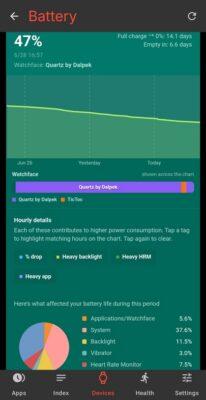
I see it arrived just on a week ago now, and although I’ve been using it a lot with testing apps, exercising, monitoring sleep, etc the battery is only now dipping below 50%. It is supposed to be good for about 3 weeks of use. Isn’t this what a smartwatch should be all about! With all my Apple Watch, Samsung Watches, LG watches, etc it was always about 2 days max battery life.
EDIT 2026-07-04: The first charge took 45 minutes from 15% to full. It actually hit 99% within 30 minutes but was probably equalising/slowed down to 100%.
I did have one glitch that was really worrying me, and that was the movement detection was just not working at all. So it was not showing any steps being walked, nor any movement during sleep. I had tried re-updating the software, rebooting it, and also using the three-button reset. I filed a bug report from inside the app, and Pebble suggested long pressing the left button for 10 seconds. It rebooted and all was fine again.
The other thing concerning me was that a handful of people had cracked the glass of the watch (out of thousands shipped). The reason is that the glass protrudes slightly above the metal body of the watch. The recommendation many had, was to download a free 3D printing file, and print a bumper to clip on the top of the watch. I did this and found an online service, in South Africa, to print a few and courier them to me. This fits like a glove on top of the watch, and it feels better protected now.
What is great about this watch is that it is open source, so the community is creating tons of useful apps for it. The Time 2 has a colour e-ink screen, a heart rate sensor, 3-axis movement sensor, a speaker and microphone, and a touchscreen. So new apps are still appearing which take advantage of these capabilities. So much can be tweaked for it compared to Big Tech watches where you get basically what they want to let you use.
So what am I actually using on it then?
Watch faces
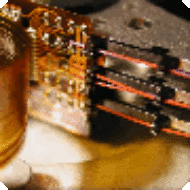
Seeing I was a Casio, and I love classic watch faces, I’m actually using Quartz by Dalpek (featured photo at top of this post). The OS is set to sound a chime on the hour (well actually it does a haptic vibration as the speaker is not yet enabled on the firmware). I also like the CORE91 watch face, but the Quartz one is by far my favourite.
Shopping
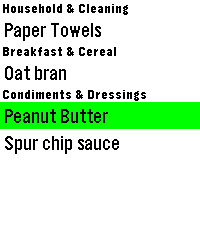
It has long been a requirement for all of my watches to have OurGroceries running on it, so I could tick off my shopping items, by aisles, as I move through the shop.
I was a bit devastated to find the old Groceries app for Pebble had not been updated since 2015, and it broke by querying an API authentication link that no longer existed. I tried to rewrite the app with Gemini and Claude, but it was just not working. In the end I found and tried Grosh for Pebble and AnyList Shopping for Shopping. My criteria are I want to set up lists on my web browser, and it must have categories for the aisles so that I can move through a shop logically and not dash back and forth for items.
Grosh fell out of the running with some clunkiness (pity as it was fully free including web browser access).
In the end the free version of AnyList Shopping actually works very well. Yes the paid version would get full web browser access, uploaded photos, prices, and quite a few other interesting extras, but the categories work well, and I can set my lists up on the phone quite fine. I was a bit put out that when opening the list on the watch, you see all 100 checked off items, and need to scroll down to the first unchecked item you want to buy. After checking the item off, it did jump straight to the next unchecked item. But kindly enough, as many open source devs are, the dev added a toggle so I could hide all the checked off items and just see my clean list when shopping. So right now I’m super happy with this shopping app.
Exercises
The Pebble watch has a pretty good exercise app built in. It records all you need, but there is no GPS in the watch, so what it pushes through to Android Health Connect, is just steps, pace, heart rate, estimated distance and calories. This would sync via Google Fit into Strava, but I wanted the GPX maps and altitudes, etc.
Accuracy-wise I was very impressed as I compared the heart readings with my Polar H10 Chest Strap, and they were either spot on, or off by about 2 to 3 bpm. Yes my Apple Watch was as good (when I had an iPhone) but the last two Samsung watches I had, were incredibly bad, sometimes lagging by 20 minutes into an exercise before it even showed the correct reading (it was so bad I took the first Samsung watch back twice for repairs). The Samsung watches never came right, and that was why I bought the Polar H10 Chest Strap, about which I did a lengthy blog post at https://gadgeteer.co.za/my-workaround-for-samsung-watch-5-exercise-tracking-using-a-polar-h10-chest-strap.
The only way around this is to use an app that works with a companion app ion the phone. That companion app will respond with the GPS tracking, using the phone’s GPS. Another way is for the watch app to query the phone’s GPS and record that.
So I narrowed it down now to about two apps to try out further. Iron is a watch app that also has a companion app on the phone. The other app is Pebble Fit which appears to query the phone’s GPS as it has no companion phone app. They both track various types of exercises with a wealth of data.
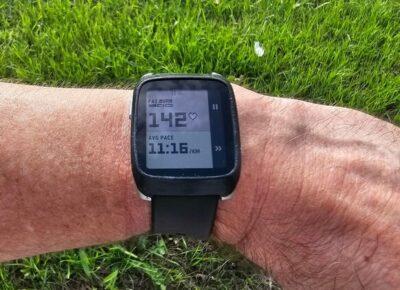
Iron has numerous customisations one can do to the stats shown on the watch, whilst Pebble Fit seems a bit more preset in this area. The image below shows the view I’m using on the watch. Clicking the middle right button scrolls through the middle row view options you set up, and the bottom right button scrolls that bottom view showing heart rate, altitude, etc graph views.
EDIT 2026-04-04: Iron updated yesterday to allow you to set the frequency of heart rate readings, and to choose a folder to auto export the GPX or TCX file into.
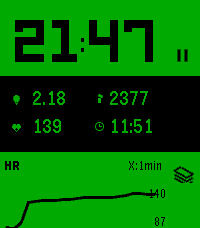
I’ve not tested Pebble Fit in the field yet, but I do like that in its settings you can set how often it should poll for the heart rate in seconds. Also in the app settings is the ability to import a GPX track, and then follow it on the watch (pretty handy for trails). The app defaults to exporting an activity to Google Drive in GPX, TCX or FIT formats. You can also trim the exercise and view it where it shows a map, heart rate zones, heart rate graph, etc. Iron app’s screen is probably easier to read though, with its larger font and clean black and white colours.
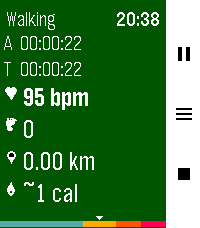
EDIT 2026-07-12: I have no tested Pebble Fit in the field. What I liked is its heart rate was accurate the whole time (I set to every 20s) so no need to readjust the strap at all. But the white on green background, with small font, is not at all easy to read, and there is no option in the settings to change the colours or font size.
Pebble Fit’s exporting of the TCX file was clunky for my purposes: I had to configure a Google Drive project (once-off basically) but it kept showing failed on the Drive side (that may be because I initially used the default access to myself only, but I did change that to anyone). Then to get it into Strava I have to download that TCX, and import it into Strava. As the export was failing, luckily there was a copy raw TCX, so I used that to create a TCX file, and was able to import it into Strava. No cadence stats shown though. The app does not export to a file on the phone at all.
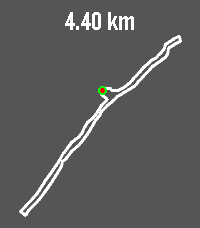
I think that Pebble Fit is intended to be a watch first app though really.
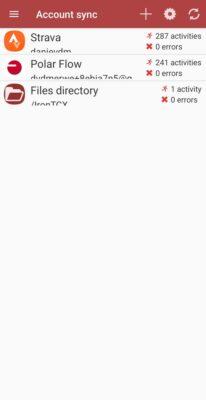
A slight “downside” is that neither will automatically export the activity directly to Strava. Part of the reason is that Strava is restricting their free API tier. So what both apps do, is it exports the GPX or TCX file to the phone (you set a folder). I found another Android phone app called SyncMyTracks, and this will do one or two-way syncing between quite a few online health services. So I’ve set it up for Strava now. Basically when I finish an exercise I just do a quick export of that file. I open SyncMyTracks and hit sync, and that’s it. It knows what it has already synced, and just syncs the new exercise activity to Strava. You could also import that file manually into Strava, but this sync is actually very slick and quick.
Notes and Memos
I did first try to use the Index feature (the one intended to work with the Pebble Index Ring). It does work perfectly from inside the phone app, but when using the Android home screen widget for quick records, it locks up the app. There is also no way right now to set up any quick launch button on the watch to trigger it (I suppose to not impact Index Ring sales?).
So I’m really tossing up still between Notes to Self and Brain Dump. Both apps activate with a button press, and you record your reminder, task, or thoughts, and they use AI to decide where it needs to go. It can go to the watch’s timeline and popup as a reminder, Brain Dump is supposed to also integrate with Google Tasks, Todoist, Nextcloud Notes, and Notion.
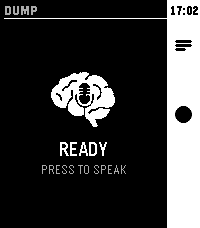
Brain Dump though has some issue with authenticating to Google Tasks, and I suspect it is a Google imposed limit for the app based on its beta test status. Whilst Notes to Self certainly pushed a reminder note into the timeline for the correct time, Brain Dump did not pop anything up at the time given (I suspect it wants to send it to one of the connected 3rd party services).
What I did to get around the “dumping” to Google Tasks, was to use Brain Dump’s webhook capability to push to my n8n hosting, which parsed the code for a to-do date, and pushed it into TickTick for my to-dos.
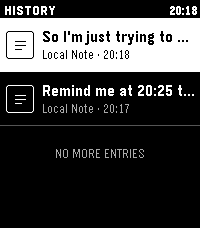
But either ways, these are useful types of apps for quickly recording something while you are driving or busy with something else.
Phone Notifications
I do have it setup to show only very select notifications such as SMS, phone calls, health notifications, notifications from my banking app, etc.
Sleep Tracking
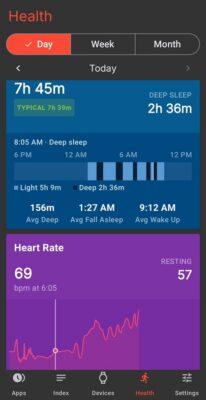
I’ve long been using Sleep as Android with all my previous smartwatches, and they also have an integration with Pebble watches. When I trigger the sleep app, the watch passes through heart rate and movement data to the app. This has been working very well, and I notice that the Pebble built-in sleep tracking also is showing my sleep data on the watch too (probably syncing via Android Health Connection service).
General
I also have the following activated in the Pebble app:
- Heart rate – take a reading every 30 minutes throughout the day
- Hourly chime – well it vibrates only right now, but nice to know when an hour is passing
- I’m using the cool white backlight on high intensity, but you can choose any colour, and there are requests logged to be able to have it switch to an alternative colour automatically at night such as a red colour
App Store
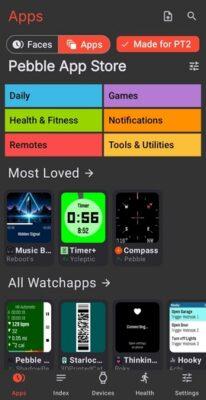
The thing is there are tons of apps and watch faces available for a single click install from the Pebble and Rebble stores. There are even alternative notifications apps to give more functionality than the built-in notification view. As new watches are busy being delivered weekly, there are also more devs getting involved and creating new and improved apps and watch faces. You can view available apps and faces at https://apps.repebble.com/apps.
Conclusion
I’m really happy to be back on a Pebble watch again. One issue that is sorted out is that the OS is now open source so we should not see an issue again with that. But remember that Rebble stepped in the previous time anyway to fill the gap.
The bigger issue may be more around the hardware longevity (repairability is not yet determined, and most smartwatches are not really easy to fix as an end user). Often it is the battery that needs replacing after 8 or 10 years (I’ve only kept my previous smartwatches for a max of 2 years).
The other thing may be around newer models to keep users interested and move with the times. Generally though Pebble watch users are not looking for the latest in fl;ashy screens and technology – they want a functional device that does all the basics, has the ability to run 3rd party open source apps, and has excellent battery life.
What we may see in future is new sensors being available as they go mainstream and cost less e.g. like blood-oxygen sensors. Pebble was not intended to be a direct replacement for Apple or Samsung watches – it was stated up front they were not going to be answering phone calls for example, compete with Apple Watch on the level of health data being tracked, or do video meetings.
What we will see though, is creative devs making very innovative use of the existing sensors in the watch, where algorithms can analyse data to provide new notifications of various situations as they arise. The new watches were only really shipped in 2026 so we can expect the app store to still grow dramatically in terms of apps and watch faces that will be available.
I’ll likely be updating this webpage as I learn and discover more. I’ll keep its date and time pinned though, as I don’t want to keep duplicating blog posts going out everywhere. But updates will be indicated with an edit date next to them.